TEAM SELECTION OR GAME OF MUSICAL CHAIRS
20 Oct 2026
Shivaji Sarkar
Delhi's proposed EV-only policy is driven by an undeniable and important objective: cleaner air and lower emissions. Few would dispute the urgency of reducing pollution in one of the world's most polluted urban regions. Yet good intentions do not automatically make good policy. By attempting to make battery-electric vehicles the dominant or exclusive mobility solution, policymakers risk allowing ambition to outrun economic, technological and infrastructural realities.
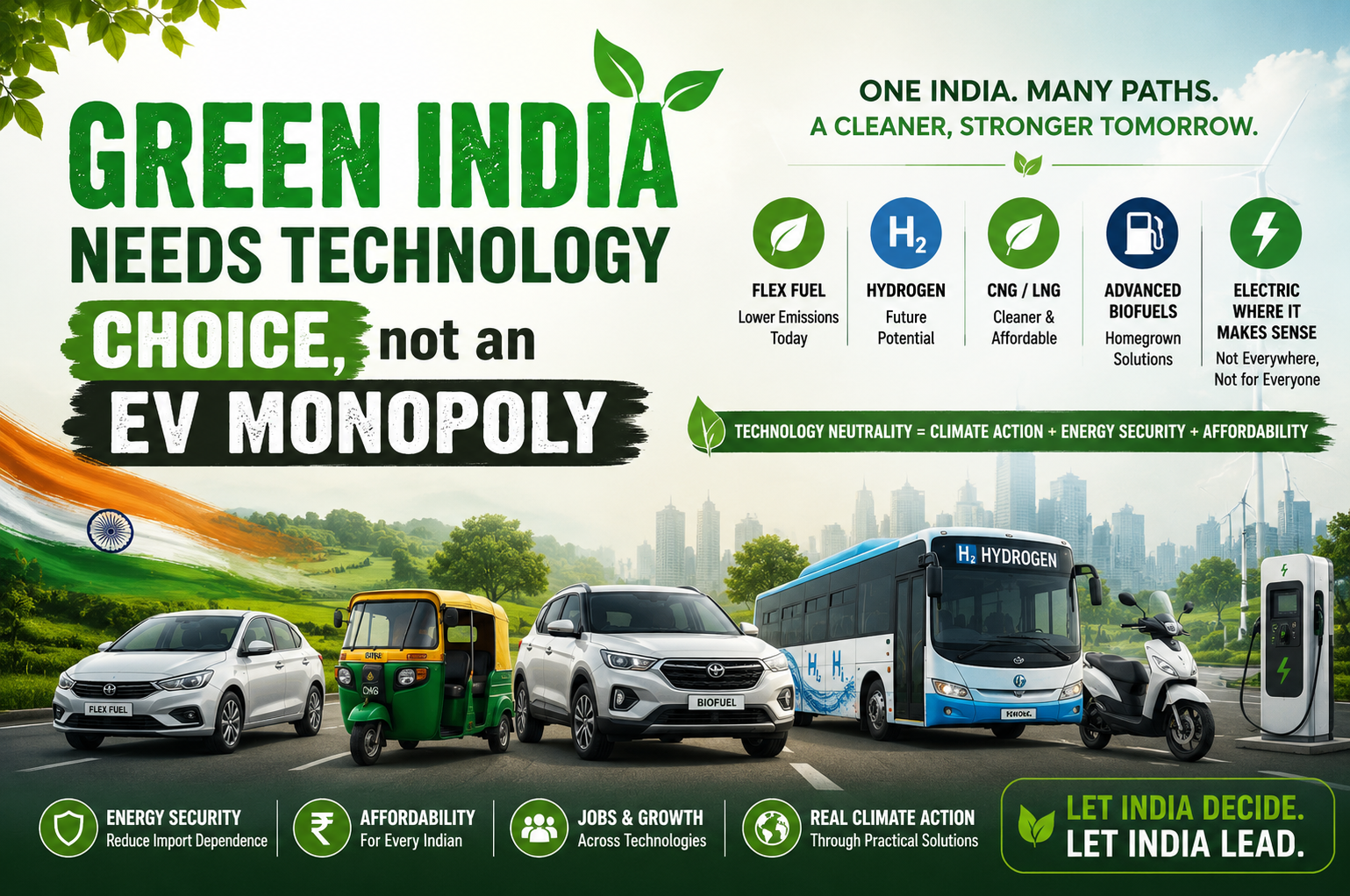
The central question is straightforward: should governments regulate emissions or prescribe technologies? Public policy should set environmental goals and safety standards while allowing innovation and market competition to determine the most effective solutions. History shows that technological progress flourishes through competition, not monopoly.
India possesses strengths across a wide range of transport technologies. Modern internal combustion engines (ICE), hybrids, CNG vehicles, biofuels, flex-fuel engines, hydrogen technologies and battery-electric vehicles all have a role to play in reducing emissions. Yet Delhi's proposed policy appears to favour one technology while sidelining others that may be more practical, affordable or environmentally suitable for many users.
Vehicle technology is evolving rapidly across the world. Manufacturers continue investing heavily in hybrids, cleaner petrol engines, biofuels, hydrogen fuel cells and battery-electric mobility. Declaring a single winner at this stage risks locking consumers and businesses into one pathway while excluding future innovations that may prove more efficient or sustainable.
Affordability remains the biggest hurdle to a rapid transition. Electric vehicles continue to carry higher upfront costs than conventional alternatives, placing them beyond the reach of millions of middle-class households, small businesses, taxi operators, delivery workers and auto-rickshaw owners. Concerns over battery replacement expenses, uncertain resale values and insurance costs further complicate the economics for ordinary consumers.
There is also the issue of import dependence. India currently spends heavily on crude oil imports, and reducing this burden is a legitimate national objective. However, replacing dependence on imported oil with dependence on imported lithium, cobalt, nickel and battery cells may simply substitute one vulnerability for another. If EV adoption expands rapidly without a domestic supply chain for batteries and critical minerals, the country's foreign exchange burden could remain substantial or even increase.
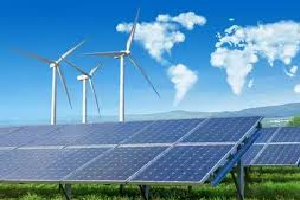
The solar sector already provides an example of the challenges associated with import dependence in strategic industries. A large share of India's solar equipment imports originates abroad, particularly from China. A similar pattern in electric mobility could expose consumers and manufacturers to global supply-chain disruptions and volatile commodity prices.
Infrastructure readiness presents another major concern. Charging networks remain unevenly distributed and are insufficient for mass adoption, particularly outside metropolitan centres. Electricity grids will also require significant upgrades if millions of vehicles are expected to charge simultaneously. An aggressive transition without corresponding investments in power generation, grid modernisation and charging infrastructure risks creating new bottlenecks while solving old problems.
Environmental considerations extend beyond tailpipe emissions. While electric vehicles eliminate emissions on the road, battery production is highly resource-intensive and involves mining and processing of critical minerals. India currently lacks a comprehensive framework for the recycling and safe disposal of millions of end-of-life batteries that could emerge in the coming decades. Without effective recycling systems, today's clean mobility solution could become tomorrow's electronic waste challenge.
Equally concerning is the premature abandonment of modern ICE technologies. Today's petrol engines and hybrid systems are cleaner, more fuel-efficient and supported by extensive refuelling infrastructure. For large parts of India, especially rural and semi-urban areas, they remain the most practical and affordable mobility option. Eliminating them through regulation rather than consumer choice risks imposing unnecessary costs on households and businesses.
The employment implications also deserve attention. Millions of livelihoods depend directly or indirectly on conventional vehicle ecosystems, including repair workshops, spare-parts manufacturers, fuel stations, transport operators and roadside service businesses. Unless large-scale retraining and transition programmes accompany policy changes, many workers may face severe disruption.
For businesses, an abrupt transition could create significant financial strain. Delivery companies, taxi fleets and small transport operators may be forced to replace vehicles before the end of their economic life, increasing debt burdens and reducing profitability. Consumers would eventually bear these costs through higher transport and delivery charges.
The environmental benefits of electrification also depend heavily on the source of electricity generation. If coal continues to account for a significant share of India's power supply, the net reduction in emissions may be smaller than headline figures suggest. Cleaner grids and cleaner mobility must progress together.
A more balanced strategy would encourage all low-emission technologies to compete on merit. Governments can support research, establish emissions standards and invest in infrastructure without excluding alternatives such as hybrids, CNG, biofuels, hydrogen or advanced ICE technologies. The objective should be lower emissions, not the selection of a single technological champion.
India's engineering strengths in internal combustion technology should not be discarded prematurely. Domestic manufacturers have developed globally competitive capabilities in engines, components and fuel systems over decades. Preserving these strengths while simultaneously investing in emerging technologies would provide a more resilient and diversified industrial base.
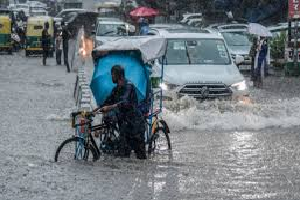
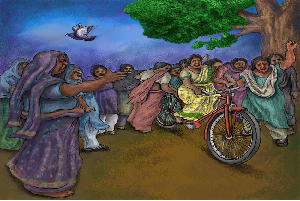
Urban transport policy should also look beyond the debate over engines and batteries. For reducing congestion and emissions in major cities, India should invest aggressively in public transport, walking infrastructure and safe cycling networks. Dedicated bicycle corridors for short-distance travel could reduce traffic congestion, lower fuel consumption and improve public health at relatively low cost.
Delhi unquestionably needs cleaner air and cleaner transport. But it also needs policies grounded in affordability, infrastructure readiness and technological realism. A successful transition must carry consumers, businesses and workers along with it rather than impose costs they cannot bear.
The goal should be clean mobility, not an exclusive commitment to one technology. Governments should define environmental outcomes and let innovation, competition and consumer choice determine how best to achieve them. The greenest India will not emerge from technological monopolies, but from openness to every solution that can reduce emissions and improve lives.
(The author is a senior journalist and media activist specialising in financial journalism.)