TEAM SELECTION OR GAME OF MUSICAL CHAIRS
20 Oct 2026
Shivaji Sarkar
New Delhi | Sunday | June 14, 2026
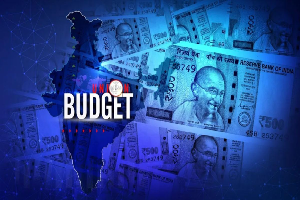
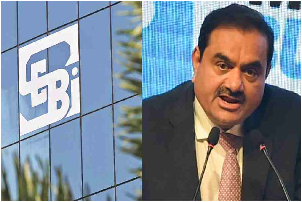
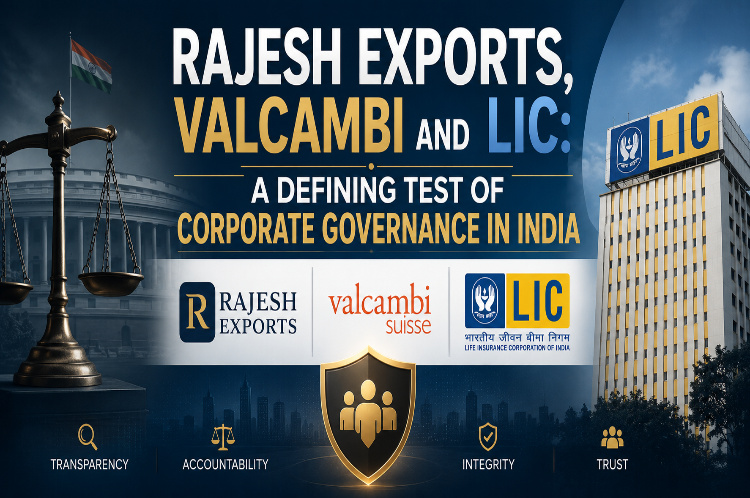
The Rajesh Exports controversy has produced one of the most staggering figures in Indian corporate history. In an interim order issued after a prolonged investigation, the Securities and Exchange Board of India (SEBI) has alleged that the company overstated revenues worth Rs 15.15 lakh crore between FY2021 and FY2025. The number is so large that it exceeds a quarter of India’s annual Union Budget and has shaken investor confidence in a company once celebrated as a global force in the gold business. More importantly, the case may become a watershed moment for corporate governance, auditing standards and regulatory oversight in India.
At the centre of the controversy is Valcambi SA, the Swiss gold refinery acquired by Rajesh Exports in 2015. The acquisition was hailed as a transformational move that positioned an Indian company at the heart of the global bullion trade. For years, Valcambi was projected as the crown jewel of the Rajesh Exports story. Today, however, the refinery finds itself at the centre of a regulatory storm.
Yet the crucial question remains: Is Valcambi the source of the problem, a victim of the controversy, or simply the window through which regulators discovered deeper issues within the group? The answer could determine the future of Rajesh Exports, its investors, auditors and perhaps India's corporate governance framework itself.
Valcambi is not a shell entity or an obscure overseas subsidiary. It is one of the world’s most respected precious metals refiners, serving banks, bullion dealers and institutional clients across international markets. According to SEBI, however, a substantial portion of the revenues reported by the Rajesh Exports group during FY2021-FY2025 originated from overseas subsidiaries, principally Valcambi and related entities.
The regulator has stated that when it attempted to reconcile these reported revenues with available records and audited subsidiary accounts, significant discrepancies emerged. This led to the explosive allegation that revenues amounting to Rs 15.15 lakh crore could not be adequately substantiated.
A critical distinction must be understood. SEBI has not alleged that Rs 15.15 lakh crore was siphoned away or disappeared. Rather, the regulator is questioning whether revenues of that magnitude genuinely existed in the form represented to investors and the market. If revenues were overstated, the issue is not necessarily missing cash but the creation of an impression of scale, growth and business activity that may not have reflected economic reality.
Such perceptions matter enormously. Revenue figures influence market valuations, investor confidence, lending decisions and corporate credibility. If the underlying numbers are found to be inaccurate, the consequences extend far beyond accounting entries.
At present, there is no public allegation from any regulator that Valcambi itself committed fraud. In fact, one interpretation is that Valcambi’s audited Swiss accounts may have helped trigger regulatory scrutiny by revealing inconsistencies that prompted deeper investigation.
Rajesh Exports has strongly contested SEBI’s conclusions. The company argues that the regulator is comparing different accounting treatments. According to its explanation, Valcambi’s standalone accounts largely record refining income and processing fees, whereas the consolidated group accounts capture the gross value of gold transactions flowing through the business.
The gold industry is unusual in this regard. Refineries often process bullion worth enormous sums while earning relatively modest margins. If this explanation ultimately withstands scrutiny, the dispute may centre on accounting presentation and disclosure standards rather than deliberate fraud. However, if regulators conclude that revenues were knowingly inflated or improperly classified, the implications could be severe.
The focus may therefore gradually shift beyond Valcambi to the wider ecosystem surrounding the company. Investigators are likely to examine how transactions were recorded across subsidiaries, how revenues were recognised and whether inter-company transactions distorted the financial picture presented to shareholders.
The role of auditors will also come under intense scrutiny. One of the most significant questions is how revenues running into trillions of rupees passed through multiple audit cycles without triggering major concerns. If discrepancies existed, why were they not detected earlier?
Independent directors and audit committees may face similar examination. Corporate governance mechanisms are intended to challenge management assumptions, test financial disclosures and safeguard minority shareholder interests. Regulators will inevitably ask whether these safeguards functioned effectively.
The controversy also raises questions for market intermediaries. Analysts, brokerages and institutional investors tracked and evaluated the company over several years. The case may prompt broader reflection on whether extraordinary revenue figures received adequate scrutiny, particularly when profitability remained comparatively modest.
An equally important question is who benefited. If SEBI’s allegations are eventually upheld, the advantages may not necessarily have involved direct diversion of funds. Potential benefits could have included enhanced market reputation, easier access to credit, stronger bargaining power with lenders and suppliers, and improved investor confidence.
The shareholding pattern adds another intriguing dimension. Between 2023 and 2026, foreign and non-resident investors reportedly reduced their holdings, while retail investor participation increased and the stock price weakened. Whether this shift carries any larger significance remains uncertain, but it is likely to attract regulatory attention.
No discussion of the case is complete without examining the role of Life Insurance Corporation of India (LIC). The state-owned insurer owns approximately 10.8 per cent of Rajesh Exports, making it one of the company’s largest institutional shareholders. The controversy has revived a recurring question in Indian financial markets: how should institutions entrusted with public savings evaluate, monitor and manage large corporate exposures?
Ultimately, the Rajesh Exports controversy may prove to be about much more than a single company. Modern corporate structures increasingly span multiple jurisdictions, accounting systems and regulatory environments. Verifying overseas operations remains one of the most difficult challenges for regulators worldwide.
If SEBI’s concerns are validated, the case could expose weaknesses in how Indian regulators monitor multinational corporate groups and assess cross-border disclosures. The implications would extend to auditing practices, revenue recognition standards, related-party transactions and investor protection mechanisms.
The next phase will be critical. SEBI is expected to continue examining documentary evidence and transaction records. Cooperation from Swiss authorities may become important if cross-border verification is required. Auditors, audit committees and institutional investors are also likely to face deeper scrutiny.
At its core, the investigation revolves around a straightforward question: can the reported revenues be independently verified? Until that question is conclusively answered, neither Rajesh Exports nor Valcambi can escape the shadow of doubt.
The larger issue transcends one company, one refinery or even one investigation. It is whether India’s financial system possesses the transparency, oversight and institutional capacity to detect such concerns before they evolve into a crisis. The answer will shape investor confidence in India’s corporate governance architecture for years to come.
The author is a senior journalist and media commentator specialising in financial and corporate affairs.