TEAM SELECTION OR GAME OF MUSICAL CHAIRS
20 Oct 2026

Do you know that an ISO 9001 certificate issued by a little-known certification body outside the usual metropolitan cities, which are business hubs like Mumbai or Bangalore, based in Bhopal or Lucknow, with accreditation from the Indian accreditation body, the National Accreditation Board for Certification Bodies (NABCB), is globally acceptable?
Surprised?
But it is true!
How does this happen?
Certainly not without a global effort which may not be visible to you.
First is by the International Organization for Standardization (ISO) where every country has a member in the form of the national standards body, Bureau of Indian Standards (BIS) from India.
It develops international consensus based standards in various sectors. One of the most important standards it has produced which have benefitted businesses globally are what are called Management Systems Standards – ISO 9001 for quality was the first one in 1987, ISO 14001 for environment in 1996, then ISO 22000 for food safety in 2005 and it goes on to cover various aspects of business – information security, occupational health and safety, energy, healthcare etc.
ISO also produces another set of standards called the ISO 17000 series which cover conformity assessment – accreditation (ISO 17011), inspection (ISO 17020), testing (ISO 17025), Management systems certification (ISO 17021 series), Product/process/service certification (ISO 17065), Personnel certification (ISO 17024) and Validation and Verification (ISO 17029) etc.
While ISO just produces standards, another organization, International Accreditation Forum (IAF), came up to oversee conformity assessment and introduced a system of evaluation of accreditation and conformity assessment bodies as per applicable ISO standards. There is yet another organization, International Laboratory Accreditation Cooperation (ILAC) which oversees inspection and laboratory related activities like testing, calibration, medical testing to name some. IAF and ILAC work in unison to exercise oversight and indeed are going to merge into a single Global Accreditation Cooperation in 2026.
The system of oversight means t6hat the certification bodies, indeed all conformity assessment bodies, and accreditation bodies are evaluated periodically for compliance to respective ISO standards and once evaluated successfully they become part of an international system of equivalence.
So when a little known certification body in India’s backyard, holding accreditation from NABCB, certifies a small or a micro business in any sector for ISO 9001 in another remote corner of India, this certificate is part of the above international system and becomes globally acceptable.
You can verify this certificate on the global database at IAF Certification Validation - IAF CertSearch
Is that not incredible? It indeed is!
What is crucial to this system?
That there are common international standards – ISO 9001 or similar management systems standards for businesses, ISO 17021 series for certification bodies and ISO 17011 for accreditation bodies. And there is system which is verifying compliance of all these bodies involved including businesses to such international standards.
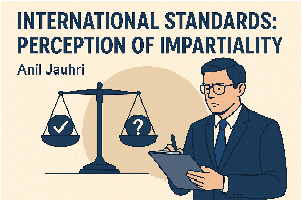
This means that if India wishes to be part of the international system and seeks global acceptance of its certifications (or inspection reports or test reports), it must adopt these standards as they are. Without any change. Whether we like them or not!!!
Indeed, there is a standard, ISO 17029, which I am personally critical of for it promotes conflicts of interest in carbon market, and NABCB nominee in my time, in the ISO committee, opposed it tooth and nail, but unsuccessfully, and India even voted negatively, but once published, I would be the first one to say we should adopt it because we would like to be part of the international system of equivalence.
Same applies to management systems standards like ISO 9001 or ISO 14001 or ISO 22000 et. al. – they are a vehicle for Indian businesses to show they are world class and therefore these should be adopted as they are.
Adoption of ISO standards as mentioned above is significant mainly in two respects:
Not to mention what has been explained above – that these standards help Indian businesses demonstrate they are world class.
Imagine my surprise then when I receive in my mailbox a notification from BIS that ISO 21001 for quality management systems in educational organizations, which is also part of international system of equivalence, is being circulated for public comments.
Why? What would we do with the comments, if any? Modify the standard? And go out of the international system?
Can we afford to modify these standards, even if there were comments?
The answer should be quite easy for anyone!!!
****************