MediaMap News Network
New Delhi I Friday I November 27, 2026
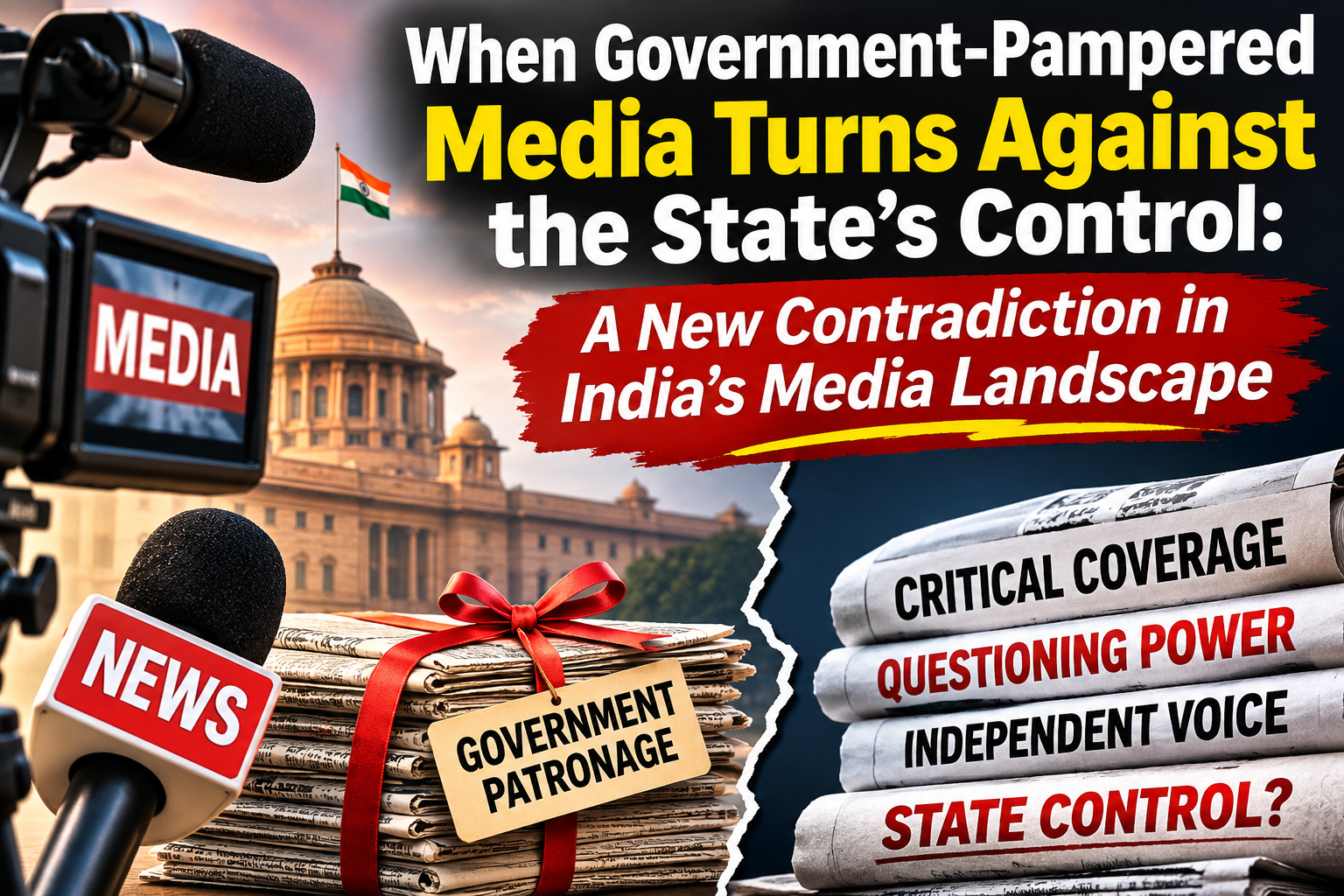
The growing confrontation between the Narendra Modi government and sections of the Indian media has thrown up an irony that deserves closer scrutiny. A government frequently accused of using its political, financial and institutional influence to marginalise independent journalism, suppress dissent and promote favourable narratives is now facing a challenge from some of the very media organisations that have benefited from the growing prominence of corporate-controlled news.
In a significant development, 21 news publishers, including media companies owned by billionaires Mukesh Ambani and Gautam Adani, have challenged the government's digital personal data protection law in the Supreme Court. They contend that the legislation, in its present form, could seriously undermine investigative journalism, compromise the confidentiality of sources and place unreasonable restrictions on the media's ability to expose wrongdoing.
The challenge is particularly noteworthy because it comes from powerful corporate media groups, rather than merely from independent journalists, civil liberties organisations or smaller publications traditionally associated with defending press freedom.
According to a Reuters report, the Digital News Publishers Association (DNPA), representing the publishers, has expressed concern that the absence of a specific exemption for journalistic activities leaves media organisations vulnerable to the law's provisions. Although the government reportedly assured publishers at an August meeting that press freedom would be protected, the absence of a written safeguard has failed to allay their apprehensions.
The publishers have pointed out that countries such as Britain, Singapore and members of the European Union have made provisions to protect journalistic activities from the full application of data protection laws. India's publishers fear that without comparable safeguards, investigative reporting could become increasingly difficult and journalists' confidential sources could potentially be exposed.
An unexpected challenge from corporate media
The political significance of this development extends beyond the legal dispute. It represents an unusual challenge to the government from business groups headed by Ambani and Adani, whose proximity to the ruling establishment has frequently been questioned by Opposition parties. Both corporations and the government have rejected allegations of preferential treatment.
For years, critics have argued that the expansion of corporate ownership in the media, coupled with the concentration of economic and political power, has weakened the diversity of voices in India's news ecosystem. Television debates dominated by government-friendly commentators, the marginalisation of Opposition perspectives and the increasing prominence of narratives aligned with the ruling party have raised concerns about the media's ability to act as an independent watchdog.
The criticism has been that sections of the mainstream media have increasingly substituted scrutiny with publicity, questioning with justification and journalism with political messaging. Opposition leaders, social activists and dissenting voices have often struggled to secure fair and sustained coverage of their concerns.
Yet the present legal challenge demonstrates that even media corporations enjoying considerable financial resources and institutional influence may find themselves uncomfortable when government regulation threatens their own professional and commercial interests.
The limits of political patronage
There is a fundamental lesson in this emerging contradiction. Media patronage, political proximity and commercial advantages may create favourable conditions for certain organisations, but they cannot permanently guarantee freedom from governmental control.
A media organisation may find it advantageous to avoid uncomfortable questions, amplify the government's achievements or give inadequate space to Opposition criticism. But investigative journalism ultimately depends upon access to information, the protection of sources and the freedom to publish material that powerful authorities may prefer to keep concealed.
If legislation creates the possibility of accessing journalists' sources, scrutinising their data or imposing compliance obligations that interfere with reporting, the consequences could extend well beyond those publications currently critical of the government.
The chilling effect could be felt across the entire media industry. Journalists investigating corruption, corporate misconduct, administrative failures or politically sensitive issues may become more reluctant to pursue stories. Sources inside government, business and public institutions may hesitate to share information if their identities are potentially exposed.
Press freedom cannot be selective
The irony is that those who remained relatively silent when independent journalists, smaller news organisations and dissenting voices faced pressure may now discover that press freedom cannot be protected selectively.
A democracy cannot have one set of freedoms for media organisations that support the establishment and another for those that question it. Nor can journalism's independence be reduced to the commercial freedom of large corporations.
The present controversy should therefore serve as a wake-up call for the entire media fraternity. Press freedom is not a privilege bestowed by governments upon compliant organisations. It is a constitutional and democratic necessity, essential for accountability and informed public debate.
The Modi government's response to this challenge will be an important test of its commitment to democratic freedoms. Equally, the willingness of powerful media corporations to defend journalistic independence will be judged not merely by their court petitions, but by whether they extend the same solidarity to journalists, smaller publications and dissenting voices that have long faced pressure.
The ultimate test of media freedom is not whether powerful publishers can protect their own interests. It is whether the weakest, most independent and most inconvenient voices in journalism can speak without fear.
Comments (0)
Share your thoughts about this news. Your comment will appear after admin approval.