Shivaji Sarkar

New Delhi I Friday I November 27, 2026
More jobs, better wages and shared responsibility are the need of the hour as India Inc. faces growing scrutiny amid an economic crisis.
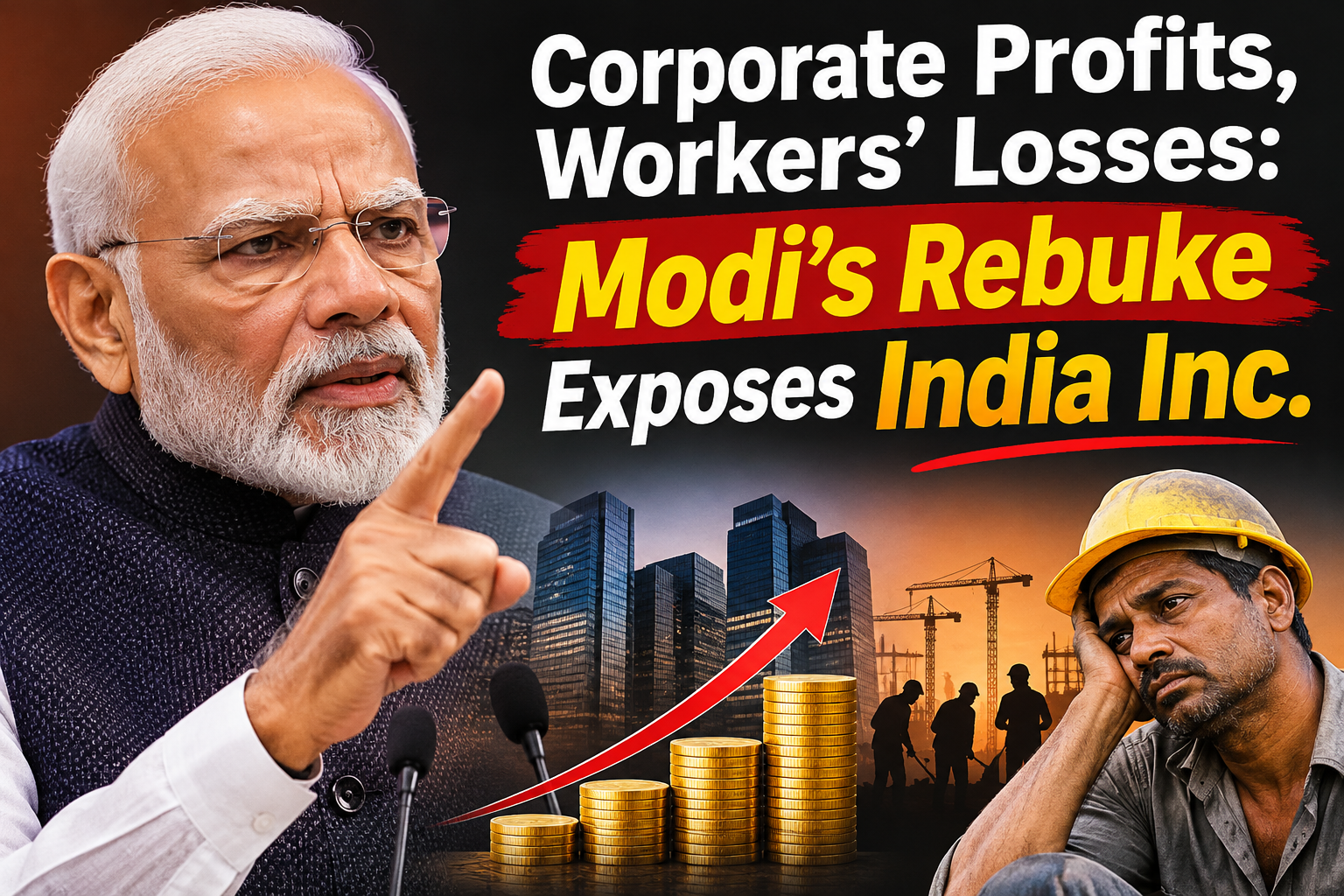
The complacent perception of corporate India has been challenged by Prime Minister Narendra Modi during his comprehensive address to business leaders at the centenary celebrations of the Federation of Indian Chambers of Commerce & Industry (FICCI). Modi highlighted critical issues concerning employment, wage growth, tax reforms, corporate responsibility and the broader state of the Indian economy, urging the business community to reflect on how government incentives have translated into tangible benefits for workers and the economy.
However, he remained silent on further privatisation of the public sector and the dismal state of several Navratna PSUs, including those in the steel and telecom sectors, which form the backbone of the Indian economy.
This realisation should have dawned years ago. The Prime Minister is raising these concerns now, and he has been candid in acknowledging that despite substantial tax concessions to industry—from corporate income tax reductions from 30 per cent to 22 per cent to GST cuts—and income-tax exemptions for individuals up to Rs 12 lakh, intended to boost consumption and turn India into a consumer-driven economy, the expected benefits have not materialised adequately.
Modi’s displeasure is evident. Industry has largely absorbed the benefits without reciprocating through job creation, better wages or greater corporate responsibility. Instead, workers have faced job cuts, rising prices and stagnant salaries.
He is right, though his intervention has come rather late, after many people have been pushed towards desperation. Many have wondered why these concerns were not raised earlier. The widespread perception that industry was being pampered had become increasingly common. Corporate defaults and labour violations were often overlooked, even when companies froze salaries, made arbitrary deductions or penalised employees for raising concerns under the pretext of “indiscipline”.
Trade unionism was frowned upon even when workers demanded fair wages, let alone legitimate compensation in keeping with rising prices reflected in the Consumer Price Index (CPI). Memories of the prolonged farmers’ agitation remain fresh.
How many employers are penalised for wage defaults—the primary trigger for many labour disputes—remains unclear, as reliable data are not readily available. According to the Labour Bureau’s Industrial Disputes reports, disputes over wages and allowances account for roughly 46 per cent of recorded industrial disputes, with the manufacturing sector contributing nearly two-thirds of these conflicts.
5,000 Laid Off—and Countless Others Dismissed Verbally
Official datasets from the Ministry of Labour and Employment record around 4,900 to 5,200 formal workers being laid off annually across central and state jurisdictions, alongside smaller numbers of formal retrenchments. This is partly because dismissing permanent workers in factories employing 300 or more people requires prior government approval under the Industrial Relations Code.
Most factory-floor workers in industrial hubs, including auto-parts, electronics and garment clusters, are employed through third-party contractors, often without written contracts. Employers routinely terminate or replace them verbally, leaving no formal retrenchment records.
Unions point out that while hundreds of workers file formal wage complaints, many more remain silent about wage theft or unlawful dismissal, fearing blacklisting and immediate job loss.
In the absence of comprehensive national figures, the scale of the problem is largely evident through localised flashpoints reported in the media.
Across Surat in Gujarat, Noida and the wider NCR-Delhi region, and Mysuru in Karnataka, thousands of workers protesting or pursuing legal claims for fair wages, overtime payments and statutory benefits have faced mass dismissals, contract termination and police detention.
The labour department is aware of the problem but remains constrained. Labour laws have been diluted, and securing justice is not easy. Judicial and quasi-judicial processes are time-consuming. While workers may have some recourse, managerial employees and higher-paid IT-sector professionals often find it even more difficult to seek redress.
Modi rightly observed: “No country can progress unless it respects its farmers, small entrepreneurs, industries, wealth creators and taxpayers. A country cannot move forward by abusing them morning and evening.”
Wage Boards Scrapped
The obvious question is why labour laws have been further weakened and wage boards virtually abolished, as industry had demanded. This is particularly difficult to justify in view of the higher profits being earned by companies.
In Q2 FY2026–27, net profits across 3,568 listed Indian companies reportedly rose 26.2 per cent year-on-year, alongside 22.6 per cent revenue growth. Nifty 50 companies recorded their fastest earnings growth in more than four years, in the range of 19–27 per cent, led by banking, financial services and insurance (BFSI), metals, oil and gas, and automobiles.
Large companies (with revenues of Rs 10,000 crore) and smaller companies (Rs 1,000 crore) reportedly recorded around 36 per cent adjusted net profit growth, compared with roughly 18 per cent for mid-sized firms. Manufacturing profits also rose to Rs 11.56 trillion in 2025 from Rs 10.73 trillion the previous year. Some industries are earning profit margins of 20 to 45 per cent.
The RBI notes that operating profits in manufacturing rose to 10.3 per cent, up from 6 per cent in 2024, with an operating profit margin of 13.9 per cent. IT services recorded operating profits of 10.7 per cent and margins of 22.4 per cent, while non-IT services posted operating profits of 7.1 per cent and margins of 20 per cent.
Yet concerns over wages, employment security and quality remain largely unaddressed.
Crony Capitalism
The problem extends beyond wages and employment. Crony capitalism is also on the rise.
An Indian billionaire, largely unknown globally, has reportedly dethroned Bernard Arnault as the world’s third-richest person, behind only Elon Musk and Jeff Bezos, with a fortune of $143 billion (€140 billion). His company’s shares have surged more than 2,400 per cent since March 2020. Rather than being viewed solely as a triumph of innovation, his meteoric rise has raised questions about widening inequality and crony capitalism, as his conglomerate relies heavily on government licences, allocations and contracts across sectors such as airports, ports, mining, aerospace and defence.
The Tata Group has, in recent weeks, reportedly expressed concerns about possible takeovers by hostile business interests. Several other companies have already been taken over or are in the process of being acquired. Some state agencies, despite having no direct connection to these transactions, are simultaneously undertaking operations that make the survival of certain businesses increasingly difficult.
Critics argue that insolvency resolutions often force creditors to accept write-offs of 70 to 90 per cent, while buyers acquire assets at steep discounts. Meanwhile, defaulting promoters allegedly exploit moratoriums and file repeated appeals to delay the 330-day resolution timeline, further eroding asset values. Section 32A immunity, they contend, can also obscure accountability for past corporate misconduct.
Severe Haircuts
The reengineered insolvency laws, including the Insolvency and Bankruptcy Code, are feared to be facilitating the takeover of distressed companies for a fraction of their value. Banks, too, are concerned about the prospect of severe haircuts in such questionable transactions.
While the Prime Minister’s concerns are genuine, the underlying processes are far from simple. Crony capitalism involves mutual beneficiaries, but it comes at the cost of essential elements of a sound economy, transparency and the principles of natural justice.
As India aspires to become a global industrial powerhouse, the balance between incentives and accountability, profits and people, must define its economic narrative.
(A senior journalist and media activist, Shivaji Sarkar specialises in writing on financial matters)
Comments (0)
Share your thoughts about this news. Your comment will appear after admin approval.